
Discovery Point Retreat Reports 43% Drop in Client Distress Across Its Full Continuum of Addiction Care
Just another WordPress site
Press Release Disclaimer: This is a press release distributed through the XPR Media network. It has not been independently verified by our newsroom.

Dallas, Texas – November 04, 2026 – Discovery Point Retreat (DPR) today released a new year of clinical outcomes data covering October 2025 through October 2026. The data tracks adults in treatment for substance use disorders at DPR’s residential facilities in Ennis and Waxahachie and its outpatient center in Dallas. The findings were collected by Discovery Point Retreat, LLC, verified by Discovery MSO, LLC, and prepared for clinical review by Lauren Reisman, LMSW, and Dr. Jerry Vaccaro, M.D.
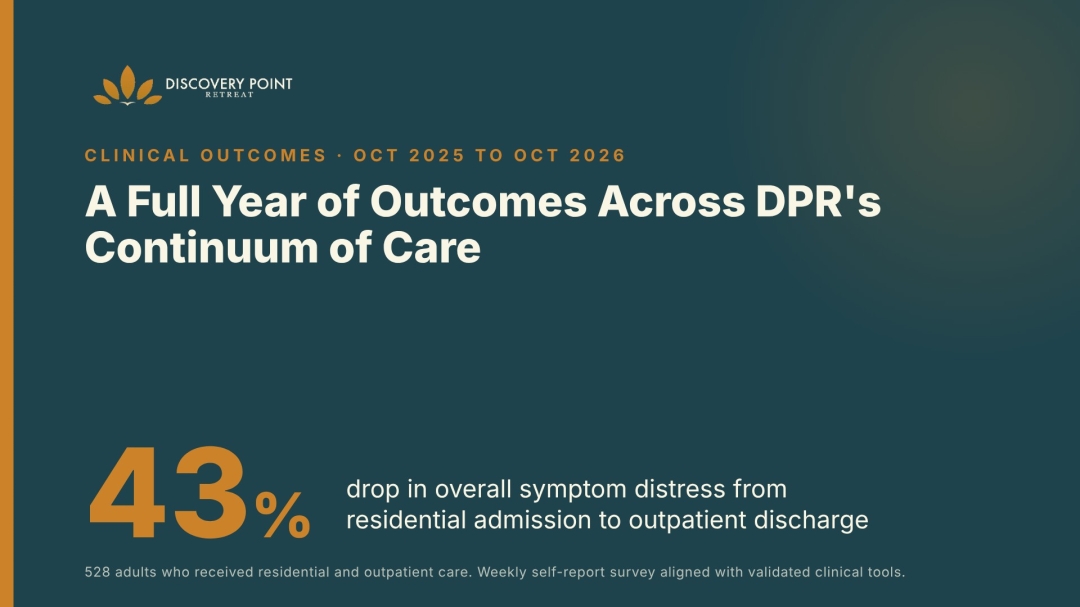
The headline result comes from 528 adults who received care at both levels: residential treatment at Ennis or Waxahachie, followed by partial hospitalization (PHP) or intensive outpatient (IOP) care in Dallas. From residential admission to outpatient discharge, overall symptom distress fell 43%, and 80.5% of these clients showed improvement.
Every clinical area in the report improved. Across the full continuum, depressive symptoms dropped 49%, anxiety symptoms dropped 38%, and trauma-related distress dropped 40%. Substance use severity, which combines use, cravings and the consequences of use, fell 58%, with 81.6% of clients improving. Relationship functioning improved 30%. Of the clients who arrived with clinically elevated depression, 72.3% scored below the clinical threshold by their last outpatient survey. Clients also rated their care highly, with 95% satisfaction with their treatment experience and their relationship with their care team.
DPR tracks progress with a weekly self-report survey that every program uses. Its questions are aligned with widely used clinical screening tools such as the PHQ-9 for depression and the GAD-7 for anxiety. Because the same survey runs from detox through IOP, the care team can follow each client’s progress across levels of care instead of starting over at each step.
Those results compare well against national benchmarks. DPR’s survey is modeled on a widely used outcome scale whose developers consider a 10-point drop in symptom distress to be a reliable, meaningful change. Clients who received care across DPR’s continuum averaged a 20-point drop. Among those continuum clients who arrived with elevated depression, 67% saw their depression scores fall by half or more, compared with 46% in a national study of 5,554 psychotherapy episodes. DPR is accredited by The Joint Commission, and this year’s results draw on 1,886 clients and nearly 10,000 weekly surveys.
Results at each facility also held up on their own. At Ennis, where 740 adults had paired surveys, overall distress fell 35% and 77.7% of clients improved. At Waxahachie, DPR’s private-room residential facility, 217 adults saw overall distress fall 31% and substance use severity fall 42%. Both facilities run the same clinical model, with detox followed by residential care that typically lasts four to five weeks.
In Dallas, where clients arrive already stabilized after residential care, the focus shifts to holding those gains while people return to work, family and daily life. Among 739 outpatient clients, substance use severity fell another 26%, and problems at work, school and home tied to use dropped 38%. Peer-group acceptance and participation in a sober lifestyle rose 22%. In the outpatient program, 96% of clients rated their treatment experience and their relationship with their care team highly.
“These numbers come from clients telling us every week how they’re doing, so we can see what’s working and adjust while someone is still in our care. The biggest takeaway is what happens when people stay connected through the whole continuum. Residential care helps someone stabilize, and outpatient care helps them build on that progress. Our strongest results come from clients who stay with us through both levels of care.” — Michael Banis, Chief Growth Officer, Discovery MSO
The outcomes reflect self-reported symptom severity and day-to-day functioning. They are not sobriety or relapse rates.
Adults in Texas looking for detox, residential or outpatient treatment can call Discovery Point Retreat at (855) 635-4776 or contact the admissions team online.
About Discovery Point Retreat
Discovery Point Retreat is a Texas-based addiction treatment provider offering medical detox, residential treatment, partial hospitalization and intensive outpatient care for adults. With residential facilities in Ennis and Waxahachie and an outpatient center in Dallas, DPR provides a full continuum of care for substance use disorders and co-occurring mental health conditions.
Media Contact
Company Name: Discovery Point Retreat
Contact Person: Michael Banis
Email: Send Email
Phone: (855) 635-4776
Address:4306 Capitol Ave
City: Dallas
State: Texas
Country: United States
Website: https://discoverypointretreat.com
Press Release Distributed by ABNewswire.com
To view the original version on ABNewswire visit: Discovery Point Retreat Reports 43% Drop in Client Distress Across Its Full Continuum of Addiction Care

